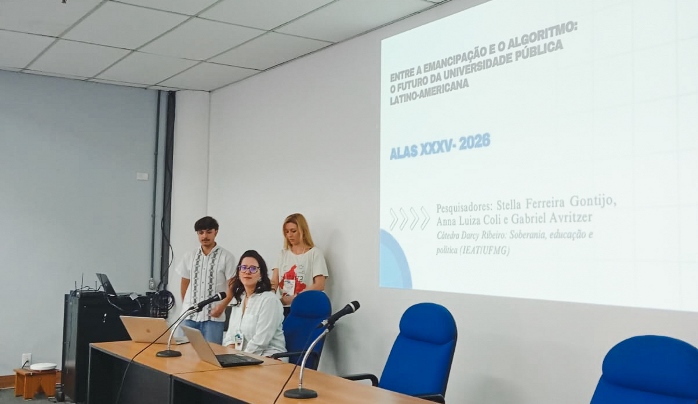
Photo: Gabriel Avritzer, Stella Ferreira Gontijo, and Anna Luiza Coli discuss the future of Latin American public universities.
Credits: Anna Luiza Coli (personal collection).
Researchers affiliated with the IEAT Darcy Ribeiro Chair: Sovereignty, Education and Politics participated in the XXXV Congress of the Latin American Sociological Association (ALAS), held between July 27th and 31st in Rio de Janeiro. This year, ALAS celebrates 75 years of existence, consolidating itself as the first regional sociological association in the world and one of the main spaces for the production and circulation of Latin American and Caribbean sociological thought.
With the theme “Between Polycrisis and Alternatives: Horizons of Latin American Critical Sociology,” the congress brought together researchers from various countries to reflect on the impacts of the overlapping political, social, economic, and environmental crises in the region, as well as on the challenges posed by the advance of authoritarianism, disinformation, and the precariousness of public universities and academic autonomy.
Between Emancipation and the Algorithm: Digital Sovereignty, Public University, and the Future of Knowledge
On July 28th, researchers from the IEAT Darcy Ribeiro Chair, Stella Ferreira Gontijo, Anna Luiza Coli (postdoctoral fellows), and Gabriel Avritzer (undergraduate research fellow), presented the work “Between Emancipation and the Algorithm: The Future of the Latin American Public University” during Session 13 of Working Group 16 (Education, Universities, and Knowledge), held at the UFRJ Science House.
The presentation revisited the Latin American tradition of defending the public university as an instrument of social emancipation, recalling the ideals of the Córdoba Reform (1918) and Darcy Ribeiro’s thinking on the university as a strategic element for the sovereignty, development, and democratization of Latin American societies.
During the presentation, the researchers argued that, in the 21st century, the crisis of the public university is not only financial or political, but also technological. According to them, the growing dependence on corporate digital platforms deepens asymmetries and weakens digital sovereignty by delegating functions previously attributed to the State to large corporations. Faced with this scenario, the study defends the need to strengthen the public university as a socially referenced institution, committed to the formation of critical subjects, to the valorization of the diversity of knowledge, and to the construction of autonomy also in the digital environment, updating Darcy Ribeiro’s thinking in the face of the advance of Big Tech on education.
The session also brought together research dedicated to gender inequalities in the production of scientific knowledge, addressing topics such as the internationalization of gender equity certifications in universities, the relationship between gender and teaching careers in Uruguay, and the presence of female authors in Brazilian social thought disciplines. Taken together, the works highlighted that the disputes surrounding the Latin American public university involve both technological transformations and the confrontation of structural inequalities present in the production and circulation of knowledge.
Latin American Integration as a University Project
Also on July 28th, Stella Ferreira Gontijo coordinated and moderated Round Table 23, on the theme “Latin American Intellectual Integration: Trajectories and Tasks,” held at the School of Communication of UFRJ. The activity brought together researchers from Chile, Uruguay, and Brazil in dialogue with Working Group 24 (Geopolitics and Regional Integration).
In her presentation, entitled “Darcy Ribeiro’s ‘New University’: The Role of the University and the Challenges of Latin American Regional Integration,” the researcher analyzed Darcy Ribeiro’s trajectory as a Latin Americanist intellectual and revisited the construction of the concept of the “new university,” formulated from the creation of the University of Brasília and deepened during the anthropologist’s period of exile between 1964 and 1976.
The presentation highlighted the university as part of a regional integration project committed to the sovereignty of Latin American peoples and showed how this proposal was interrupted by military dictatorships, but reappeared decades later in initiatives such as the Montevideo Group Association of Universities (AUGM) and the Federal University for Latin American Integration (UNILA).
The debate was complemented by presentations on Latin American academic networks, the institutional challenges of regional integration, the presence of the idea of Latin America in Brazilian social thought, and new interpretations of dependency theory. Taken together, the panel reaffirmed intellectual integration as a central element in building institutions.