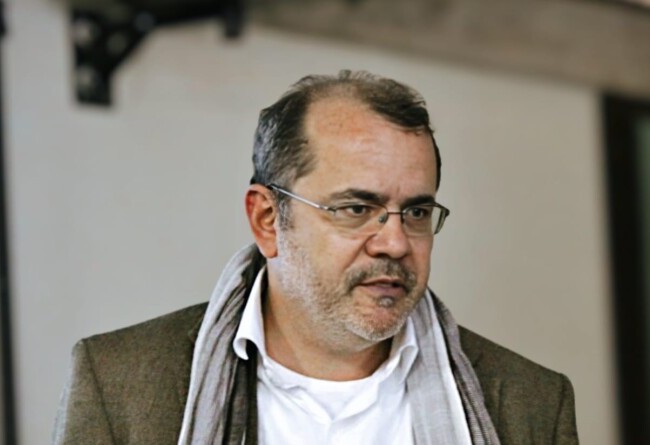
Ernesto Perini: an explanatory model for disinformation.
Professor Ernesto Perini-Santos, from the Faculty of Philosophy and Human Sciences (Fafich) and coordinator of the Network for Studies on Democracy and Disinformation (REDD) linked to the Research Groups program of IEAT/UFMG, is the author of the book Living is Easy with Eyes Closed, a work that investigates the conceptual and political roots of contemporary disinformation. Published by Editora UFMG, the book reflects debates on fake news, scientific denialism, and conspiracy theories at a time when the country faces decisive challenges in rebuilding social trust and protecting democratic institutions. According to Perini, the work, launched in October, seeks to explain “how and why we lost the common ground that makes collective life possible.”
As the professor argues, “the current crisis of trust in institutions is not episodic and has two structural factors: the modification of the way information circulates on the internet and the growth of social inequality. The internet offers a space without epistemic and moral filters, which increases the visibility of different types of denialism and makes it difficult to read reliable sources of information.” According to Professor Perini, the social corrosion produced by inequality is capable of affecting mental health, school performance, and institutional trust. Thus, the ground is fertile for disinformation dynamics.
Imbalance
Anchored in research from epistemology, social psychology, the sociology of knowledge, and the anthropology of beliefs, the book suggests that misinformation is not a simple cognitive error, but a structural imbalance that arises from the friction between large-scale social coordination and the mechanisms of belonging that structure political identities. The work examines how these mechanisms collide in the digital environment, whose fast-paced, fragmented dynamics, susceptible to artificial impulses, erode the authority of institutions, from universities to health systems.
The discussion proposed by the philosopher explores the concept of common ground, the shared knowledge that guides everything from everyday actions to vaccination campaigns and electoral processes. By presenting beliefs as “maps of the world,” Perini dissects notions of trust and epistemic vigilance, fundamental for operating in an “inevitably asymmetrical cognitive environment.” In discussing motivated cognition and identity signaling, the philosopher shows how beliefs function as markers of affiliation. “We adopt certain narratives because they situate us morally and politically. This framing helps to understand why, often, denying facts becomes a way to protect identities and group ties,” he observes.
The work also seeks to explain how the phenomena of fake news, scientific denialism, and conspiracy theories offer identity comfort in contexts of uncertainty and weakened institutions. For Perini, these concepts are not “products of ignorance,” but of a scenario in which weakened institutions leave vacuums that opportunistic actors quickly fill.
At this point, the author also dissects the structural causes of the imbalance: the infodemic, the architecture of digital platforms, the unregulated information market, the convergence of affiliations, and the political role of the far-right. “The far-right exploits both the unfiltered moral and epistemic space of the internet and the worsening social indicators,” he states. “Here in Brazil, it’s possible to find a landmark: the election of Jair Bolsonaro in 2018, which was preceded by the first election of Donald Trump and Brexit in 2016. It’s a continuous process; the election of Bolsonaro and other far-right actors was long gestated by the growth of social suffering and the change in the informational environment,” he illustrates.
According to Perini-Santos, recent studies have analyzed millions of tweets in various countries and identified that misinformation largely originates from the far-right. Maintaining an unregulated environment, she argues, “is not a side effect, but a political and economic objective.” “There is a convergence of interests here: maintaining an unfiltered space and economic deregulation, which serves the interests of large technology companies,” she emphasizes.
Contemporary Disputes
The professor also proposes an explanatory model for disinformation. The central point, according to him, “is that the dissemination of knowledge in human cultures depends on trust, because human cultures are cooperative and cumulative – in contrast to non-human cultures.” Perini further observes that belonging to groups functions as an important marker of trust. Thus, when certain groups demand that their members reject a specific set of beliefs, and these beliefs represent the best available knowledge about the world in a given domain, fertile ground for denialism arises. This logic, explains Perini, helps to understand the distribution of different types of denialism in the contemporary world.
In the book’s conclusion, the author situates the debate on misinformation within the context of major contemporary disputes, especially the climate crisis. He argues that global warming highlights the limits of distrust: although few fully understand climate models, we all depend on them to guide decisive collective actions. “A more just society is also a society that trusts science more,” he summarizes.
Perini also highlights the ongoing institutional reconstruction efforts in the country, including federal government initiatives aimed at promoting science and strengthening the public sphere. Reflecting on possible paths to restoring informational balance, he states: “If I am correct, rebalancing can only be achieved if there is a change in the factors that explain the imbalance, that is, a reduction in inequality and the regulation of social networks.”
The author, however, considers that none of these actions, in isolation, produces broad effects: “Regulating networks is part of the answer, but it is only part of the solution. Regulation will always be partial in relation to how misinformation circulates online. How, for example, can we regulate the spread of flat-Earth theory or control misinformation about vaccination?” he asks. The public school, the professor emphasizes, has an essential role in providing tools to overcome denialism. “But this is also only part of the answer we seek,” assesses Professor Ernesto Perini-Santos.
With information from: UFMG portal (Cedecom)