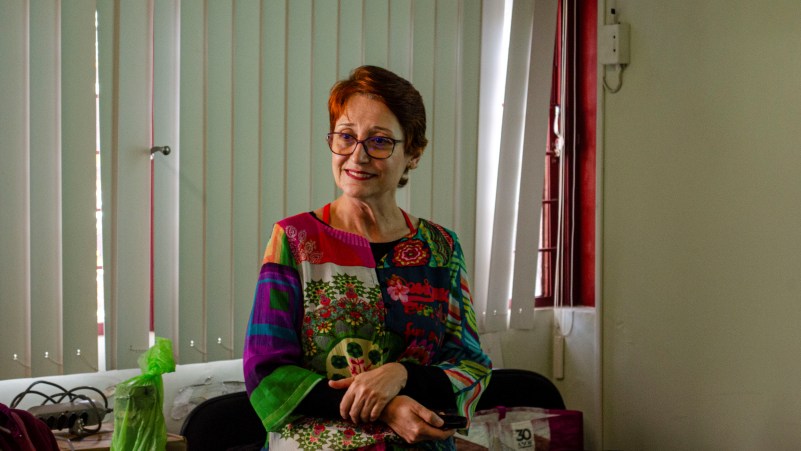
Luciana Diniz Silva, from the Department of Clinical Medicine.
Photo: Taniara Damascena – IEAT/UFMG
Last Wednesday, July 2, IEAT hosted the presentation of the project “Historical, Cultural and Social Analysis of Body Image”, led by Professor Luciana Diniz Silva, from the Department of Clinical Medicine at the UFMG School of Medicine. The initiative is part of IEAT’s Residency program and seeks to investigate, from a transdisciplinary perspective, how the social construction of the body — especially the notion of “standard body” — was consolidated throughout the 20th century, between 1911 and 1949, based on the collection of the Medical Memory Center (Cememor).
The project combines history, health sciences, philosophy and the arts to critically analyze how medical practices, the teaching of anatomy and scientific advancement in Brazil were immersed in eugenicist discourses that, to this day, reverberate in the training of health professionals and in the representation of bodies in academic spaces. According to the researcher, the central hypothesis is that eugenicist ideas and conceptual structures, deeply present in 20th century medical training, shaped normative standards of beauty, health and bodily identity, silencing ethnic and gender diversity.
During the presentation, Professor Luciana highlighted that the motivation for the project arose amid the COVID-19 pandemic, a period that had a profound impact on her, both personally and professionally. “The pandemic made me reflect on the body as a political, symbolic and historical territory. It exposed inequalities, exposed the limits of technical medicine and deepened the invisibility of certain bodies”, she stated. It was in this context that her commitment to transdisciplinary research was strengthened, an approach that she considers essential to understanding the complex interactions between science, health, society and subjectivity. “Only through transdisciplinarity can we build ethical, inclusive and transformative responses to contemporary challenges”, she added.
The project team brings together teachers, researchers and students from different areas of knowledge. Participating in the initiative are Professor Eugênio Paccelli da Silva Horta (Visual Arts – School of Fine Arts), Professor Rita Marques (History), Professor Luciano Amédée Péret Filho (Pediatrics), Professor Kennedy Martinez de Oliveira (Anatomy), Librarian Ráisa Mendes Fernandes de Souza, Historian Ethel Mizrahy Cuperschmid and students Aline Marcos Pires (PhD student in Nutrition), Lucas Carreira Nunes and Leonardo Barcelos Carvalho (undergraduate in Medicine), as well as Vanessa Fernandes de Nobrega and Guilherme Orzil Rosa (undergraduate in Visual Arts – School of Fine Arts).
One of the project’s central focuses is the critical analysis of body representations in anatomical atlases and medical books from Cememor. According to the professor, many of these images reproduce eugenic patterns and exclude racialized and female bodies. “I was shocked to discover that many of the atlases used historically were constructed from the bodies of concentration camp prisoners. To this day, our medical students do not find representations of black or female bodies in the books they use to study anatomy,” Luciana reported.
In addition to documentary research, the project focuses on integrating science and art to promote a sensitive and pluralistic reflection on the body. An example of this proposal is the exhibition “Art, History and Health: Museum as a Connection for Transdisciplinarity”, created by student Thâmara Cunha Carvalho, from the Visual Arts course. The exhibition included a memorial in honor of the victims of COVID-19, allowing visitors to offer flowers in recognition of those who lost their lives during the pandemic.
Another highlight of the presentation was the debate on the “invisibility of the body” in contemporary medical practice. For the professor, the exclusive focus on the disease often dehumanizes care. In this sense, the project also developed workshops and dynamics with patients, such as those held in liver nodule outpatient clinics, in which participants were invited to draw their organs or the way they perceive their own health condition. One of the most symbolic reports was that of a patient who drew a butterfly when referring to his liver, saying: “I cut this here because I feel that what I have inside my liver is a butterfly. Something that transforms, flies and goes away”.
For Professor Luciana, these initiatives demonstrate that healthcare goes beyond examinations and technical diagnoses. “When the patient expresses himself and sees himself as part of the process, he forgets the traditional medical environment. The consultation ceases to be just a clinical act and becomes a space for listening, expression and transformation,” she highlighted.
The appreciation of a humanized and attentive approach to patients is one of the methodological pillars of the project, which also explores the historical legacy of eugenic discourses in Brazil. One of the objects of analysis is the work “A Cura da Fealdade” (The Cure for Ugliness) (1923), by Renato Kehl, a defender of eugenics in the country, who treated ugliness as a supposed “disease” to be combated. According to the professor, understanding the impact of these narratives is essential to reflect on the current search for exclusionary body standards and their social and psychological effects.
The project developed at IEAT represents an innovative effort to rethink health education from a transdisciplinary, critical and diversity-sensitive perspective. By promoting dialogue between different types of knowledge and bringing science, art and history together, the initiative contributes to the construction of more inclusive, humane and socially responsible medical practices.