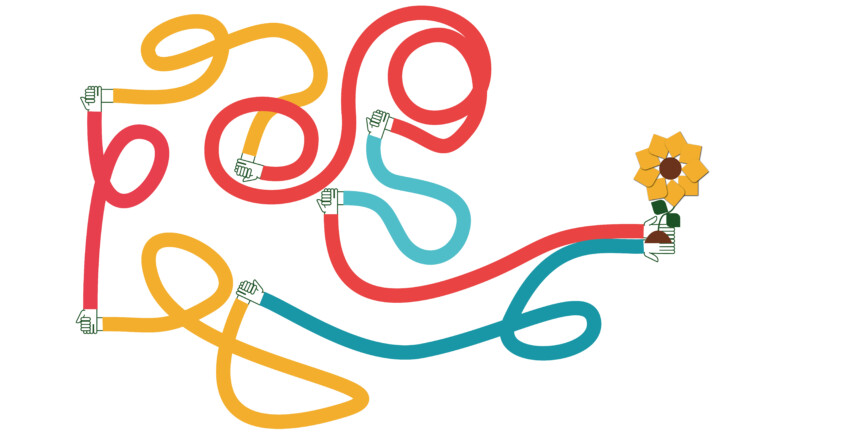
In several fields, the knowledge produced by UFMG already reaches a transdisciplinary dimension.
Art: Gabriel Lisboa | UFMG
UFMG debuted in the Times Higher Education Interdisciplinary Ranking, a classification that evaluates the interdisciplinary activities and actions developed by universities. The ranking considers the resources allocated to this field, the initiatives implemented by the institutions, the quantity and quality of interdisciplinary publications, the impact of citations in multiple areas, and the global reputation of the universities. In the survey recently released by Times Higher Education (THE), UFMG appears in the 201–250 range worldwide, occupies ninth place in Latin America, and is in fifth position among Brazilian institutions – third among federal universities.
The methodology used by THE is based on three variables. The first, process, considers how universities organize their interdisciplinary actions, including goals, the existence of centers dedicated to the field, administrative support, and career incentives for cross-disciplinary work. The second, inputs, measures the resources allocated to interdisciplinarity, such as specific funding for interdisciplinary research and fundraising from industry. The third variable, outputs, refers to the results achieved, evaluating the quantity and quality of interdisciplinary publications, the impact of citations in multiple areas, and the institution’s overall reputation.
Although international rankings often present biases that do not align with the reality of Brazilian universities, Rector Sandra Goulart Almeida positively assesses the emergence of a ranking focused on interdisciplinarity in higher education. “Cutting-edge knowledge is no longer produced confined within rigid boundaries. The future of science is clearly interdisciplinary and transdisciplinary. The result of this evaluation highlights a dimension in which UFMG has invested significantly in recent years to guide the direction of its scientific production,” states the rector.
According to the rector, the new THE survey, to some extent, aligns with the recent QS ranking for sustainability initiatives, in which UFMG advanced 470 positions, reaching 316th place overall, standing out as the university that progressed the most among the two thousand evaluated. “A sustainable future is strongly conditioned by a science capable of breaking disciplinary boundaries,” she states.
“This is the second edition of THE’s ranking focused on interdisciplinarity. The ranking brings together some of the largest and best higher education institutions in the world. It is a joy for UFMG to be among the global references in the production of interdisciplinary science,” says Professor Dawisson Belém Lopes, director of the Institutional Data Governance Office (EGDI) at the University.
Far beyond the sum
“The ranking measures the university’s ability to operate in an interdisciplinary manner, but UFMG goes beyond that, as it conducts its academic activities focusing on the research problem and how that problem crosses different disciplines. The University organizes its processes in a transversal and transdisciplinary way across various domains,” says the director of the Institutional Data Governance Office.
As Dawisson Belém observes, the ranking measures the interdisciplinarity of universities, but UFMG already stands out for its transdisciplinary approach. While interdisciplinarity promotes dialogue between disciplines, integrating them in teaching and research, transdisciplinarity advances towards the unity of knowledge, articulating distinct areas of knowledge to deepen the understanding of the world’s complexity.
“Being transdisciplinary is essential for the university to be up to contemporary challenges. The major problems of our time – climate change, social inequalities, the crisis of democracy, the impacts of new technologies, and public health issues – cannot be contained within a single area of knowledge. They require effective dialogue between different fields of knowledge, articulation between natural sciences, humanities, technology, the arts, and integration with non-academic knowledge,” explains Professor Patrícia Kauark, director of the Institute for Advanced Transdisciplinary Studies (IEAT) at UFMG.
Patrícia Kauark adds that a transdisciplinary university forms not only specialists, but citizens capable of understanding the complexity of the world, acting responsibly, and producing socially relevant knowledge. “It’s about strengthening the university’s public commitment to society. Transdisciplinarity goes beyond the sum or simple interaction between disciplines. It implies placing different theories, methods, and languages in dialogue, but also opening the university to listening to other forms of knowledge – social, cultural, artistic, traditional – in search of more integrated, creative, and socially situated solutions.”
In addition to having a body dedicated to promoting transdisciplinarity – the IEAT – UFMG develops several actions that strengthen dialogue between areas in undergraduate and graduate teaching, research, and outreach. Among these initiatives, transversal training programs at the undergraduate level and structuring projects that articulate multiple fields of knowledge stand out, such as the UFMG Program for Citizen Training in Defense of Democracy.
“These examples demonstrate that transdisciplinarity is already part of the institutional daily life of UFMG. In the specific case of Ieat, we create conditions for intellectual encounters that would hardly occur in the traditional formats of academic units. Through international chairs, seminars, conferences, researcher residencies, study groups, and thematic projects, we stimulate the formation of research networks that cross areas, promoting dialogue between science, philosophy, arts, health, technology, and social knowledge. Thus, Ieat contributes to consolidating a more open, plural institutional culture oriented towards complex problems,” concludes Kauark.
With information from: UFMG portal (Cedecom)